
Hear from Our Customers
Commercial buildings in Memphis deal with something most metro contractors don’t fully account for — the relentless cycle of Michigan winters followed by humid summers. Paint that wasn’t applied right, or with the wrong products for this climate, starts showing its age faster than it should. Peeling edges, bubbling surfaces, and faded facades aren’t just cosmetic issues. They signal to customers, tenants, and anyone driving down M-19 that maintenance has been deferred.
When the surface prep is done right and the right coatings are used for eastern Michigan’s conditions, you’re not repainting every two years. You’re getting a finish that holds through the freeze-thaw cycles, the lake-effect moisture coming off Lake Huron, and the temperature swings that hit this part of the state hard every single season.
Memphis sits on the Macomb and St. Clair county line, and a lot of the commercial building stock here is older — structures that have already been through decades of Michigan weather. That means the prep work matters more, not less. A thorough clean, the right primer, and a properly applied finish coat can extend the life of your exterior significantly. Inside, proper coating selection keeps walls looking clean and professional through the humidity fluctuations that older commercial buildings in small Michigan cities tend to experience.
We’re a family-owned painting company operated by two brothers with more than 10 years of hands-on experience in the trade. We’ve been running under the Legends Construction name for about two years, but the experience behind it goes back well over a decade of working on Michigan properties — interior, exterior, residential, and commercial.
When you hire us, you’re not getting a crew dispatched by someone who’s never seen your building. You’re working directly with the people whose name and reputation are on the line with every project we take on. In a community as close-knit as Memphis — where word travels fast between Macomb and St. Clair county neighbors — that kind of personal accountability isn’t just a selling point. It’s how we actually work.
Our focus has always been straightforward: do the best possible work, charge a fair price, and make sure the customer is satisfied enough to call again. That approach has built a 4.9-star rating and a client base that grows mostly through referrals. If you’re looking for a commercial painting company near you in Memphis that treats your property like it matters, that’s exactly what you’ll get here.
It starts with a straightforward walkthrough of your property. Before any paint gets mixed or any equipment comes out, our crew takes a close look at what you’re working with — surface conditions, existing coating failures, any areas showing moisture damage or substrate issues that need to be addressed before paint goes on. For older commercial buildings along the M-19 corridor, this step often reveals more than the surface suggests, and skipping it is exactly how you end up repainting sooner than you planned.
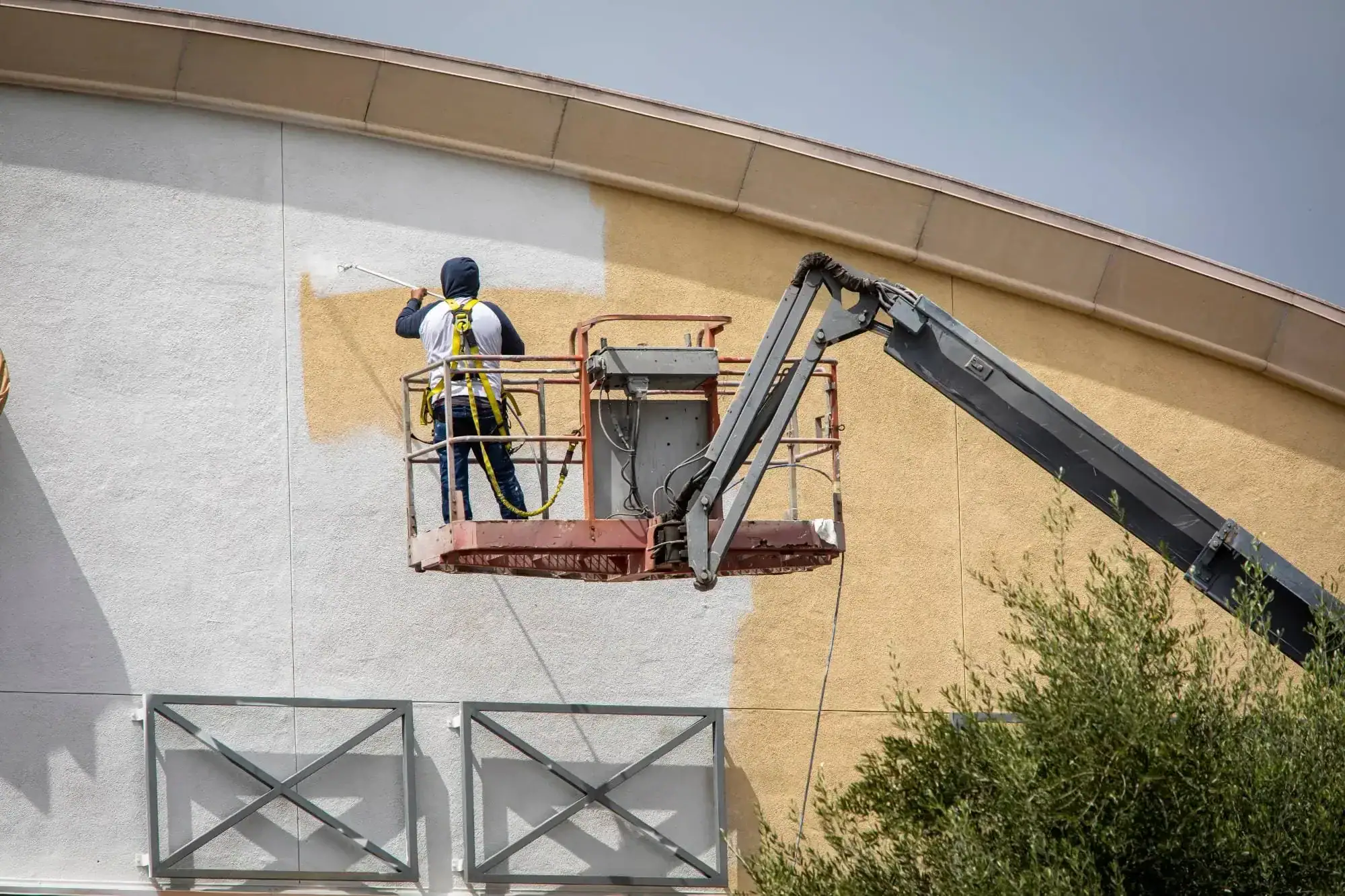
From there, surface preparation is the priority. That means cleaning, scraping where needed, patching, and priming — the work that most people don’t see but that determines how long everything else lasts. For exterior projects in Memphis, timing matters. The reliable painting window for exterior commercial work in Michigan runs from roughly late April through October, with May through September being the most consistent stretch. If you’re planning an exterior project, booking early is worth it — the good contractors fill their summer and early fall schedules quickly.
For interior commercial painting, the calendar is more flexible. A lot of Memphis business owners schedule interior work during slower months to minimize disruption to their operations. We work around your hours — early starts, phased room-by-room work, whatever keeps your business running while the job gets done. The goal at the end of every project is simple: the work looks right, it’s built to last in Michigan’s climate, and you don’t have to think about it again for a long time.

Ready to get started?
Commercial painting for Memphis properties covers more ground than most people initially think. On the exterior, that includes facades, soffits, doors, trim, and any structural surfaces that take the brunt of Michigan’s weather. On the interior, it’s walls, ceilings, trim work, accent areas, and any surface that needs to look clean, professional, and hold up under daily use. We handle all of it — no coordinating between separate crews for inside and outside work.
For commercial properties in Memphis that were built before 1978 — and there are quite a few of them along the M-19 corridor — lead paint compliance is a real consideration. Under EPA Renovation, Repair and Painting rules, contractors working on pre-1978 buildings must follow certified procedures for containment and disposal. We handle this properly, which protects both your property and your business from liability exposure. It’s worth asking any contractor you’re considering whether they’re equipped to handle this — not all of them are.
Because Memphis straddles the Macomb and St. Clair county line, commercial property owners sometimes deal with different permit requirements depending on which side of the line their building sits on. If your project is part of a broader renovation scope, it’s worth confirming applicable requirements with the City of Memphis directly. We’re fully licensed and insured for commercial painting work throughout both counties, so whichever side of that line your property falls on, the coverage and compliance are already in place.
For exterior surfaces in Michigan, a well-applied commercial paint job on a properly prepared surface typically lasts five to seven years — sometimes longer if conditions are favorable and maintenance is kept up. The honest answer for Memphis specifically is that the freeze-thaw cycle accelerates wear faster than in more temperate parts of the country. Every winter, temperatures swing above and below freezing repeatedly, forcing moisture into any micro-crack in the paint film. Over time, that adds up to peeling, bubbling, and surface failure.
Interior commercial painting has a longer useful life — generally seven to ten years depending on traffic, cleaning frequency, and the type of space. High-traffic areas like entryways, hallways, and customer-facing spaces tend to show wear sooner. The best approach is to do a visual inspection every couple of years and address problem areas before they spread, rather than waiting until a full repaint becomes unavoidable. Catching early failure spots is significantly cheaper than letting them deteriorate into a full-scale project.
It matters more than most people expect. Commercial painting jobs involve different surface types, different coating requirements, different scheduling constraints, and often different compliance considerations than residential work. A commercial building has to stay functional — you can’t just close it down for a week the way you might approach a house repaint. The crew needs to work around business hours, coordinate with tenants or employees, and manage the job in a way that keeps disruption to a minimum.
The products we use are also different. Commercial-grade coatings are formulated for higher durability, easier cleaning, and longer service life under heavier use conditions. For exterior work on older commercial buildings in Memphis — many of which have accumulated multiple layers of paint over decades — the prep work and product selection require a different level of attention than a standard residential job. Hiring a contractor who primarily does residential work for a commercial property isn’t automatically a problem, but it’s worth asking specifically about their commercial experience and how they handle the scheduling and compliance side of the job.
In most cases, painting alone — whether interior or exterior — does not require a building permit in Michigan. Paint is generally considered a maintenance activity rather than a structural alteration, so the permit threshold typically doesn’t apply. However, if your painting project is part of a broader renovation that includes structural repairs, siding replacement, or other work beyond coating application, permit requirements may come into play depending on the scope and cost of the overall project.
The added complexity for Memphis properties is the dual-county situation. Because the city straddles the Macomb and St. Clair county line, the applicable local requirements can vary depending on where your property sits. For any project where there’s ambiguity, the safest move is to check directly with the City of Memphis before work begins. For pre-1978 commercial buildings — which covers a significant portion of Memphis’s older commercial stock along M-19 — EPA lead paint rules apply regardless of permit status, and those requirements are non-negotiable. A licensed contractor will handle this as a standard part of the job.
Commercial painting costs vary based on square footage, surface condition, number of coats required, and whether the work is interior, exterior, or both. For a straightforward interior repaint of a small commercial space — a storefront, a small office, a reception area — you’re generally looking at a few hundred to a couple thousand dollars depending on size and prep needs. Larger exterior projects on multi-story or multi-surface commercial buildings can run significantly higher, particularly when surface prep is extensive.
For Memphis specifically, older building stock often requires more prep work than newer construction — more scraping, more priming, more attention to surfaces that have weathered multiple Michigan winters. That prep work adds to the upfront cost but reduces the frequency of repaints over time, which is where the real savings are. A cheaper quote that skips proper preparation is almost always more expensive in the long run. The best way to get an accurate number for your property is to have someone walk the building with you and give you a quote based on what they actually see — not a ballpark pulled from a square footage formula.
The key is scheduling and communication upfront. Before any work starts, it’s worth having a direct conversation with your contractor about your operating hours, your customer-facing spaces, and any areas that absolutely cannot be taken offline during business hours. A contractor who has real commercial experience will build the project schedule around those constraints — not expect you to work around theirs.
For Memphis businesses, interior painting during slower months is a common and practical approach. Many small business owners along the M-19 corridor schedule interior work in late fall or winter when foot traffic is lower and the disruption is easier to absorb. For exterior work, the Michigan painting season runs late April through October, so there’s a natural planning window. Phased approaches — working section by section rather than shutting down an entire space — are standard for occupied commercial buildings and don’t add significantly to the overall project cost when they’re planned from the start. The goal is that your customers notice the fresh result, not the process that produced it.
Larger regional painting companies that operate out of Metro Detroit or Port Huron aren’t necessarily doing bad work — but small-city commercial jobs in places like Memphis often aren’t their priority. When your project is one of dozens on a schedule, response times slow down, crews get shuffled, and the attention to detail that a smaller job requires can get lost in the volume.
A locally rooted contractor serving the Memphis area has a different incentive structure. In a community of just over 1,000 people straddling two counties, reputation is everything. A paint job on a storefront along M-19 doesn’t stay quiet — it gets talked about. That accountability drives a higher standard of care on every project, because the next job often comes directly from the person who saw the last one. For Memphis commercial property owners who want a contractor that treats their building like it matters — not like a filler job between bigger metro projects — that local accountability is worth a lot.