Summary:
Michigan’s climate is particularly brutal on wooden decks. You’re dealing with temperature swings from 15 below zero in January to 95 degrees in July. That constant expansion and contraction stresses wood fibers in ways that milder climates never see.
Professional deck staining creates a protective barrier that addresses multiple threats at once. The stain penetrates deep into the wood grain rather than sitting on top like paint does. This matters because it allows the wood to breathe while still blocking moisture and UV rays from breaking down the cellular structure underneath.
When moisture gets into untreated wood and then freezes, it expands by roughly 9%. When it thaws, the wood contracts again. Repeat that cycle 30-40 times each winter across Macomb County and Oakland County, and you get the warping, cupping, and cracking that shortens deck life dramatically. Quality stain with waterproof wood sealant properties interrupts that destructive cycle before it even starts.
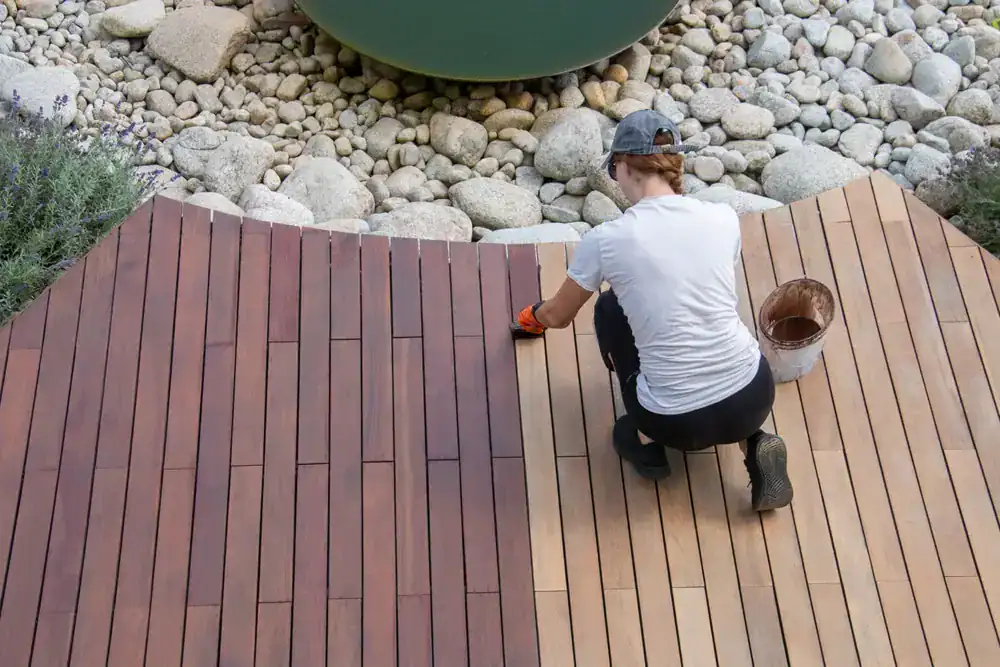
The sun does more damage to your deck than most homeowners realize until it’s too late. Ultraviolet rays break down lignin, which is the natural polymer that holds wood fibers together. Without that structural integrity, wood becomes brittle, develops surface cracks, and loses its original color within months.
You’ve seen this transformation if your deck has gone from rich brown to silvery gray. That’s not just cosmetic. Those UV-damaged fibers are weaker, more porous, and significantly more susceptible to moisture infiltration, splintering, and eventual rot that requires board replacement.
Professional-grade deck stains include UV inhibitors that act like sunscreen for your wood. Semi-transparent and solid stains offer varying levels of protection—the more pigment in the stain, the more UV rays it blocks. For decks in full sun exposure, which is common across residential properties in Macomb County and Oakland County where many yards have open southern exposure, this UV protection for wood becomes essential rather than optional.
The difference shows up clearly in longevity. An untreated deck might start showing significant UV damage within 6-12 months of installation. A properly stained deck maintains its structural integrity and appearance for 2-5 years, depending on the stain type and daily sun exposure. That’s not marketing language—that’s the measurable difference between wood fibers that stay intact versus ones that break down and require expensive replacement.
Here’s what matters for your specific situation in Michigan. If your deck faces south or west, you’re getting the most intense UV exposure during peak afternoon hours. Those are the decks that benefit most from stains with higher pigment content and stronger UV blockers. East-facing decks get morning sun, which is less intense but still damaging over time. North-facing decks have the least UV exposure but still need protection from moisture and the temperature fluctuations that stress wood differently.
The outdoor living space trends for 2026 show homeowners investing more in their backyards than ever before—up to 25% of total home improvement budgets. That makes protecting those investments with proper deck maintenance even more critical to long-term value.
Water is the primary enemy of wood decks in Michigan. Not just from rain, but from snow melt that sits for weeks, morning dew that soaks in daily, spring humidity that keeps wood damp, and even sprinkler overspray from lawn watering. When water penetrates untreated wood repeatedly, it creates the perfect environment for mold, mildew, and wood rot to develop and spread.
Wood rot doesn’t announce itself with obvious signs until it’s already advanced to expensive stages. By the time you notice soft, spongy boards or see visible fungal growth on the surface, you’re often looking at $500-1,500 in board replacement rather than simple maintenance. That’s the expensive outcome that proper professional wood staining prevents before damage starts.
Quality deck stains include water repellent properties—some formulas use penetrating oils, others use wax-based compounds. Both approaches work, but they function differently in Michigan’s climate. Oil-based stains penetrate deeper into the wood grain and provide longer-lasting protection against moisture infiltration. Water-based stains dry faster and have less odor during application, but may require more frequent reapplication in Michigan’s wet spring seasons when decks face constant moisture exposure.
The waterproofing aspect does more than just keep water out of the wood. It also prevents the swelling and shrinking cycle that happens when wood absorbs moisture and then dries out completely. This dimensional stability is what keeps your deck boards from warping, cupping, or developing the gaps and raised edges that make surfaces uneven and unsafe for bare feet.
In Macomb County and Oakland County specifically, spring brings heavy rain and snow melt that can leave standing water on poorly maintained decks. Fall brings more rain plus leaf debris that traps moisture directly against your deck surface for weeks. Winter brings snow that sits frozen for extended periods. That’s nine solid months of significant moisture exposure every single year. Professional deck staining creates a barrier that gives water nowhere to go except off your deck surface, rather than soaking into it where damage occurs.
You’ll notice the difference immediately in how water behaves on your deck. On a properly stained surface, water beads up into droplets and rolls off within minutes. On untreated or poorly stained wood, water soaks in immediately and darkens the wood—that visible darkening means moisture has penetrated and is now trapped inside the wood fibers where it causes damage.
Want live answers?
Connect with a Legends Painting expert for fast, friendly support.
The gap between professional deck staining and DIY attempts is wider than most homeowners expect before they try it themselves. It’s not about whether you’re personally capable—it’s about the preparation process, product selection for Michigan’s climate, weather timing, and application technique that all have to align correctly for results that last years instead of months.
Most DIY deck staining failures happen during prep work, not during the actual staining application. If the wood isn’t thoroughly cleaned down to bare fibers, the stain won’t penetrate properly no matter how carefully you apply it. If the wood isn’t completely dry after cleaning, you’ll trap moisture under the stain layer. If you skip proper sanding, the surface won’t accept stain evenly and you’ll end up with blotchy, uneven color. These aren’t small details that only perfectionists care about—they’re the fundamental difference between stain that lasts 3-5 years versus stain that peels and fails within 6-12 months.
Professional deck staining includes specific steps that seem minor but matter significantly for long-term results. Wood brighteners restore the natural pH balance after cleaning and open up the wood grain for better stain absorption. Proper pressure washing technique removes contaminants, mildew, and old stain residue without damaging wood fibers or raising the grain. Sanding with the correct grit creates a consistently porous surface across the entire deck. These processes take experience to execute correctly, especially on older decks with existing damage.

Here’s what actually happens during professional deck staining in Michigan, and why each step matters specifically for decks in Macomb County and Oakland County where weather conditions are particularly demanding.
First comes thorough cleaning that goes beyond what a garden hose can accomplish. This means removing all dirt, mildew, algae, old stain residue, and organic material that’s accumulated on the surface and between boards. In Michigan specifically, spring often leaves decks covered in thick yellow pollen, winter leaves them with road salt and sand residue tracked up from driveways, and fall deposits leaves that create dark tannin stains when they decompose. All of that contamination has to come off completely, or the new stain won’t adhere properly to the wood underneath.
Next comes wood brightening, which most DIY projects skip entirely. This step neutralizes the cleaning chemicals and restores the wood’s natural color by removing oxidized surface fibers that make wood look gray and weathered. It also adjusts the pH level of the wood, which directly affects how well stain penetrates into the grain. Skip this step, and you often end up with blotchy, uneven color that looks amateurish no matter how carefully you applied the stain.
Sanding follows brightening, but only after the wood is completely dry—usually 24-48 hours depending on weather conditions. This opens up the wood pores and creates a smooth, consistent surface that accepts stain evenly. The key is using the right grit sandpaper—too coarse and you damage the wood fibers and create grooves, too fine and you actually seal the pores shut. For most deck applications in Michigan, 60-80 grit works well for opening the grain without causing damage.
Then comes stain selection, which isn’t about picking a color you like from a fan deck. It’s about matching the stain type to your specific wood species, your deck’s sun exposure throughout the day, and Michigan’s climate demands. Pressure-treated pine, cedar, and redwood all require different stain formulations. A deck in full southern sun needs significantly more UV protection than one that’s partially shaded by trees or structures.
Application technique matters more than most people realize until they see the difference. We work in thin, even coats rather than trying to get maximum coverage in one heavy pass. We back-brush to work stain into the wood grain rather than letting it pool on the surface where it stays tacky. We pay close attention to temperature and humidity, only applying when conditions fall within the manufacturer’s specifications—usually 50-90 degrees with humidity below 50% and no rain forecast for 24-48 hours.
Finally, there’s the drying and curing process that determines whether your stain job lasts years or fails within months. Stain needs specific conditions to cure properly—usually 24-48 hours with no rain, no heavy dew, and temperatures consistently above 50 degrees. In Michigan, finding a 2-3 day window with those stable conditions can be genuinely challenging in spring and fall when weather shifts rapidly. We track weather forecasts carefully and plan application timing accordingly, sometimes rescheduling projects multiple times to ensure proper curing conditions.
The most expensive deck staining mistakes aren’t dramatic failures that show up immediately—they’re the subtle errors that look acceptable initially but fail within 6-12 months, forcing you to start over. Here’s what actually goes wrong most often and why it matters for your budget and timeline.
Staining wet or damp wood is probably the most common error, especially in Michigan where humidity stays high through spring and fall. Pressure-treated lumber is often shipped very wet and needs 4-6 weeks minimum to dry before it’s ready for stain. Even existing decks can hold moisture for 2-3 days after rain, especially in shaded areas or between closely spaced boards. When you trap that moisture under a layer of stain, it eventually pushes back out as temperatures rise, taking the stain with it. You end up with peeling, flaking, and large areas where the stain never properly adhered to begin with.
Applying stain in wrong weather conditions ruins more projects than any other single factor in Michigan. If it’s too hot—above 90 degrees—stain dries on the surface before it penetrates into the wood grain. Too cold—below 50 degrees—and it doesn’t cure properly, leaving a tacky surface that attracts dirt. Too humid, and it takes days to dry instead of hours, creating a sticky mess. Michigan weather is unpredictable enough that timing becomes absolutely critical. Spring and early fall offer the most reliable conditions, but even then you need to watch forecasts carefully and be ready to reschedule if conditions shift.
Using too much stain seems like it would provide extra protection, but it actually creates significant problems. Excess stain that doesn’t penetrate into the wood sits on the surface and forms a thick, tacky layer. This attracts dirt and footprints, shows every imperfection, and eventually peels off in sheets rather than wearing away gradually. Thin, even coats that fully penetrate and dry properly perform dramatically better than thick applications every single time.
Skipping proper surface preparation is where the majority of DIY projects fail before staining even begins. Cleaning with just a garden hose isn’t remotely enough to remove mildew, algae, and embedded dirt. Power washing without proper technique and the right nozzle can gouge wood fibers and raise the grain, creating a rough surface. Failing to remove old peeling stain or failing to sand properly creates an uneven surface that shows through the new stain. Each of these shortcuts shows up clearly in the final result—blotchy color, poor adhesion, premature wear in high-traffic areas.
Choosing the wrong stain type for your specific situation wastes both money and time. Transparent stains look beautiful on new wood and show off the natural grain, but they offer minimal UV protection and typically need reapplication every 1-2 years. Solid stains provide maximum protection against UV damage and moisture but hide the wood grain completely, making your deck look painted rather than naturally stained. Semi-transparent stains offer a practical middle ground that works well for most Michigan decks, but even within that category, oil-based and water-based formulas perform very differently in terms of penetration, durability, and maintenance requirements.
The cost of these mistakes adds up faster than most homeowners anticipate. A DIY staining project might save $400-800 in professional labor costs initially, but if it fails within a year due to any of these common errors, you’re paying for stripping, sanding, and complete reapplication. That’s easily $1,000-1,500 when you factor in materials, equipment rental, and either your time or professional correction. Compare that to professional deck staining done correctly the first time with proper prep, right products, and correct timing, and the economics shift significantly in favor of doing it right from the start.
Your deck represents a significant financial investment in your home and your lifestyle—typically $8,000-15,000 for a quality wood deck, more for larger or elevated structures. In Macomb County and Oakland County, where outdoor living spaces have become true extensions of the home rather than simple afterthoughts, that investment deserves protection that actually works through Michigan’s demanding climate.
Professional deck staining isn’t about making your deck look presentable for one summer season. It’s about creating a protective barrier against UV damage that breaks down wood fibers, moisture infiltration that causes rot and mold, and the freeze-thaw cycles that warp and crack untreated boards. It’s about extending the functional life of your deck from 10-15 years to 20-25 years or more with proper maintenance. It’s about avoiding the $5,000-15,000 replacement cost that comes from neglect and deferred maintenance.
The seven benefits—UV protection for wood, waterproof wood sealant properties, rot prevention, extended lifespan, enhanced appearance, splinter prevention, and increased home value—all depend entirely on proper execution. That means thorough surface preparation, climate-appropriate product selection, correct application technique, and timing that accounts for Michigan’s unpredictable weather patterns. When those elements align correctly, you get protection that lasts 2-5 years rather than failing within months.
If your deck is showing gray weathering, rough spots where wood has started to splinter, or water that soaks straight in rather than beading up on the surface, those are clear signs that protection has failed and damage is actively occurring. We specialize in deck staining that addresses Michigan’s specific climate challenges, using proven processes and quality materials that perform in real-world conditions across Macomb County and Oakland County. Our focus is straightforward: complete the work correctly using proper deck maintenance techniques so it protects your investment long-term and you don’t have to think about it again for years.
Article details:
Continue learning: