
Hear from Our Customers
Royal Oak sits in Oakland County with a climate that swings more than 60 degrees between January lows and July highs. That range — combined with the repeated freeze-thaw cycles your deck absorbs every winter — is exactly what causes wood to crack, cup, and warp over time. A professionally stained deck with a penetrating moisture barrier stops that cycle before it compounds into something expensive.
Royal Oak is known as the “City of Trees,” and while that canopy is one of the things that makes neighborhoods like Vinsetta and Normandy Oaks so desirable, it creates a real problem for decks. Shaded surfaces stay damp longer after rain, dry slowly, and become prime environments for mold and mildew growth. Professional-grade deck staining includes mold-inhibiting formulas that handle what shade and moisture leave behind — something a hardware store brush-on product simply won’t do at the same level.
The financial case is straightforward. Professional deck staining in Royal Oak typically runs $1,500 to $3,000. Full deck replacement can cost $10,000 to $30,000 or more. Staying on a two-to-three-year staining cycle is one of the most cost-effective maintenance decisions a Royal Oak homeowner can make — especially when your home’s value is already reflecting what Oakland County real estate commands.
We are a family-owned, owner-operated painting and exterior coating company serving Royal Oak and the surrounding Oakland County communities. With over 10 years of combined painting experience between two brothers who personally oversee every project, there is no crew of anonymous workers dispatched to your home without oversight. The people who give your estimate are the same people doing the work.
That matters in Royal Oak, where homes in neighborhoods from Pinewood Manor to South Royal Oak represent serious investments and homeowners have high expectations. You are not handing your deck over to a rotating team — you are working directly with contractors who have a personal stake in the outcome and a track record built on repeat business from Royal Oak residents.
We are fully licensed under Michigan state contractor requirements and carry the insurance that protects your property. A 4.9-star customer satisfaction record backs up everything we say here — but you can verify that independently before you ever pick up the phone.
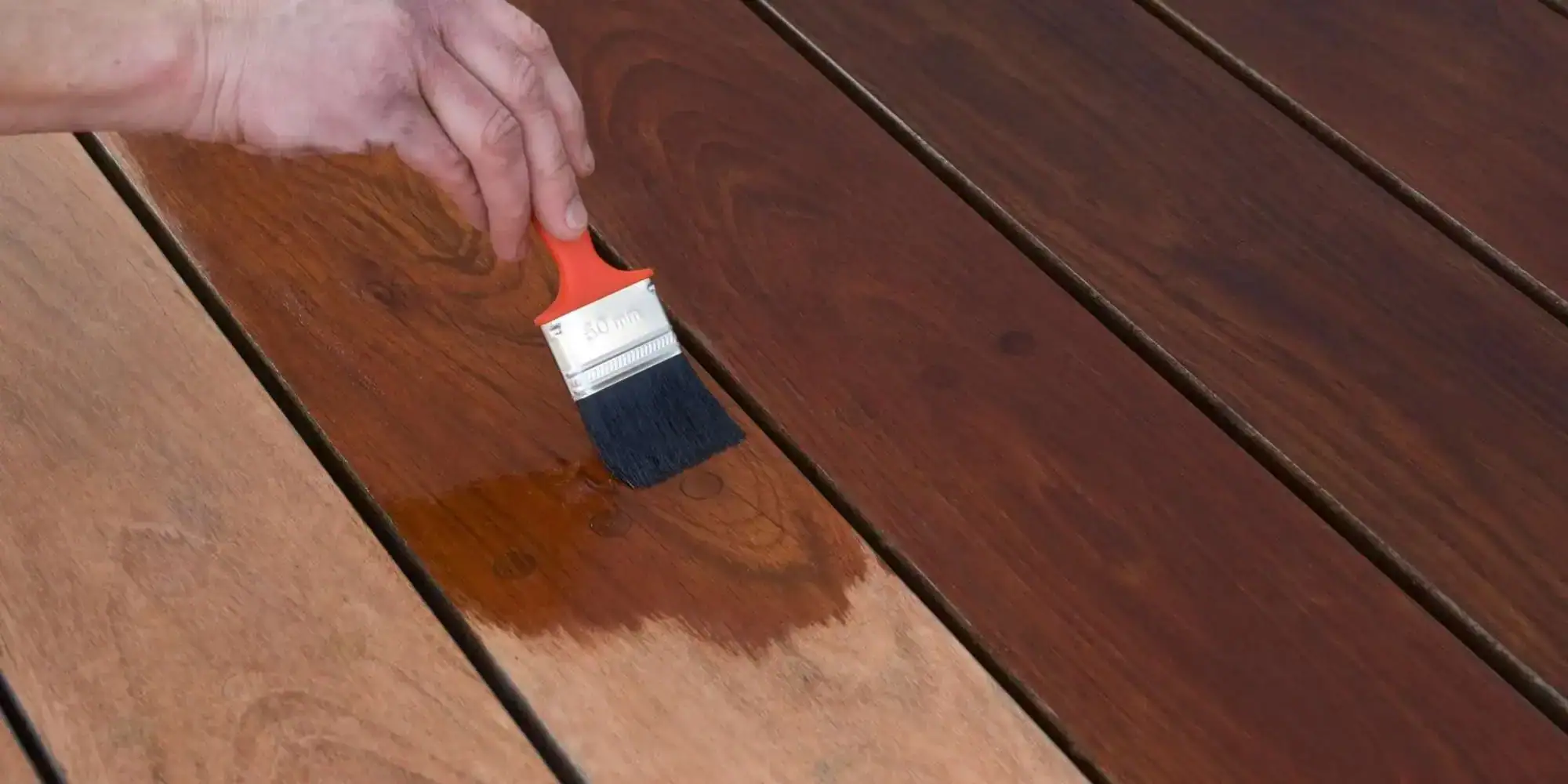
Every deck staining project in Royal Oak starts with an honest assessment. Royal Oak’s housing stock skews heavily toward homes built between the 1920s and 1960s, which means many decks have been stained, restained, or painted multiple times — sometimes with incompatible products layered over each other. Before anything goes on, we look at what’s already there, what condition the wood is in, and what prep work is actually needed. That assessment drives everything else.
From there, the deck gets a thorough power wash to strip biological growth, dirt, and any loose material. Royal Oak’s tree canopy means shaded decks accumulate more organic debris than most homeowners realize — and staining over that layer is one of the most common reasons a deck stain fails early. Once the surface is clean and fully dry, we apply the stain in the right conditions. In Royal Oak, that window runs roughly from late April through early October, when temperatures stay between 50°F and 90°F and humidity is workable. Timing matters here — stain applied outside that window won’t cure properly, and another Michigan winter will undo the work fast.
The final result is a deck that is sealed against moisture, protected from mold, and visually sharp. No permit is required for deck staining as a maintenance service in Royal Oak, so there is no waiting on approvals — just scheduling, prep, and execution.

Ready to get started?
Deck staining in Royal Oak is not a one-step job, and any contractor who treats it like one is cutting corners you will notice within a season. What we deliver starts with surface preparation — power washing to remove mold, mildew, algae, and debris that Royal Oak’s shaded lots accumulate more than most. If the existing stain is peeling or incompatible with what goes on next, that gets addressed before a drop of new product touches the wood.
The staining itself uses professional-grade exterior products selected specifically for Michigan’s climate demands — penetrating formulas that seal wood grain against moisture rather than sitting on top of it. For Royal Oak homeowners with larger or more complex deck structures, particularly in higher-value areas like Vinsetta, we assess the full scope before quoting so there are no surprises on the back end. Competitive, transparent pricing is a core part of how we operate — you know what you are paying and why before the job starts.
Beyond the deck boards themselves, we address railings, steps, and any adjacent wood surfaces that need attention. The goal is a cohesive, protected finish that holds up through Oakland County’s full seasonal range — not just something that looks good in photos the week after it dries.

In Royal Oak’s climate, most wood decks need professional staining every two to three years — though the actual timeline depends on the wood type, the quality of the last application, and how much sun and shade exposure your deck gets. Royal Oak’s tree canopy is a significant factor here. Decks under heavy shade stay damp longer after rain and are more susceptible to mold and mildew growth, which can degrade a stain finish faster than UV exposure alone would.
A simple test: pour a small amount of water on the deck surface. If it beads up, the existing stain still has life in it. If it soaks in quickly, the wood is no longer protected and it is time to restain. Waiting too long — especially heading into another Michigan winter — means the wood absorbs moisture through the freeze-thaw cycle, and the damage that follows is cumulative. Staying on a consistent staining schedule is significantly cheaper than addressing the structural consequences of skipping it.
The optimal window for deck staining in Royal Oak runs from late April through early October. You need surface temperatures between 50°F and 90°F, low humidity, and no rain in the forecast for at least 24 to 48 hours after application. Royal Oak’s humid continental climate means the summer months can push humidity high enough to interfere with proper curing, so late spring — after the last frost clears but before peak summer humidity — and early fall are typically the best windows.
Missing that window has real consequences. Stain applied when temperatures drop below 50°F will not cure correctly, leaving the wood vulnerable going into winter. Royal Oak winters start early and repeat freeze-thaw cycles throughout the season. Scheduling in spring gives the stain a full cure cycle before temperatures drop, which is the strongest position your deck can be in heading into November. If you are thinking about it now, the right move is to get it scheduled before the calendar fills up.
Professional deck staining in Royal Oak typically runs between $1,500 and $3,000 for a full project, including prep work, power washing, and stain application. The range reflects real variables: deck size, current condition, how much prep work is needed, and whether railings and steps are included. A deck that has been well-maintained and is on a regular staining schedule will generally cost less to service than one that has been neglected for several seasons and needs significant prep before stain can go on.
For Royal Oak homeowners in higher-value areas — particularly in neighborhoods like Vinsetta where larger, more complex deck structures are common — the total can run higher depending on scope. What you should not do is compare a professional staining quote to a low-bid estimate that skips the prep work. A stain applied over dirty, mold-covered, or incompatible old product will fail early, and you will pay for the job twice. The $1,500 to $3,000 range for a properly executed project is a fraction of what deck replacement costs, which routinely runs $10,000 to $30,000 or more in this market.
No — deck staining as a maintenance service does not require a building permit in Royal Oak. Royal Oak’s Building Division requires permits for new construction, structural additions, and major alterations, but routine maintenance work like staining and sealing an existing deck falls outside those requirements. That means no waiting on approvals, no inspection scheduling, and no added timeline delays before the work can start.
That said, the absence of a permit process also means there is no regulatory checkpoint to catch substandard work. When you hire an unlicensed contractor or someone cutting corners on prep, there is no inspection that flags it — you just end up with a stain that fails in one season and wood that continues to deteriorate underneath. Michigan state law requires painting contractors to hold a state license for projects over $600, which means they have completed required education and passed licensing exams. Hiring a licensed contractor like us is the quality checkpoint that the permit process does not provide for maintenance work.
Stain penetrates the wood fiber and seals it from within, while paint sits on top of the surface as a film. For exterior decks in a climate like Royal Oak’s — where freeze-thaw cycles, moisture, and temperature swings are a seasonal reality — penetrating stain is almost always the better long-term choice. Paint forms a surface layer that can peel, crack, and trap moisture underneath, which accelerates the wood deterioration it was supposed to prevent. Once paint starts peeling on a deck, the prep work required to fix it properly is significantly more involved than maintaining a stained surface.
Stain also allows the wood to breathe, which matters in Royal Oak’s humid summers when decks absorb ambient moisture. A penetrating stain lets that moisture move in and out of the wood without building up pressure that causes surface failure. The visual result is also different — stain enhances the natural grain and texture of the wood, while paint covers it entirely. For most Royal Oak homeowners with natural wood decks, stain delivers better protection, lower long-term maintenance cost, and a more natural appearance.
It depends on what is already on the surface and what condition it is in. If the existing coating is peeling, flaking, or failing — which is common on older Royal Oak homes where decks may have had multiple products applied over the years — that material needs to come off before anything new goes on. Staining over a compromised surface traps the problem underneath and guarantees an early failure. The prep work in that scenario is more involved, but skipping it is not an option if you want the new stain to actually hold.
If the existing stain is in reasonable condition and compatible with the new product, a thorough cleaning and light prep may be sufficient. The assessment at the start of every project is specifically designed to answer this question for your deck — not assume it. Royal Oak’s housing stock includes a lot of older homes with layered exterior history, and what is already on a deck surface varies significantly from property to property. The only way to give you an honest answer is to look at the actual deck, which is exactly what we do before any quote goes out.