Wondering what professional painting services actually cost? This guide breaks down real Michigan pricing, hidden factors, and what you should expect when budgeting for your project.
Summary:
You’ve been staring at those walls for months now. Maybe it’s the scuff marks that won’t scrub off, or the color that looked great in 2015 but feels dated now. You know it’s time to paint, but here’s where it gets tricky: you have no idea what this should actually cost.
You’ve heard horror stories—contractors who quoted one price and charged another, paint jobs that peeled within a year, estimates that varied by thousands of dollars for the same work. And the internet? It gives you ranges so wide they’re basically useless.
Here’s what you actually need to know about professional commercial painting services in Macomb County, MI and Oakland County, MI. Real numbers, real factors, and the questions you should be asking before anyone touches your walls.
Professional painting services in Macomb County, MI and Oakland County, MI typically run $2 to $6 per square foot for interior work and $1.80 to $2.50 per square foot for exterior projects. That’s the baseline, but it’s not the full picture.
A standard 12×12 bedroom might cost $300 to $800. A whole-home interior repaint could run $3,000 to $10,000 depending on size and condition. Exterior painting for a 2,000-square-foot home averages $3,600 to $5,000 in Michigan as of 2026.
Labor makes up 60 to 75 percent of your total cost. Materials, prep work, and overhead account for the rest. Understanding this split helps you evaluate quotes and spot where contractors might be cutting corners or padding numbers.

Square footage is the starting point for most painting estimates, but it’s not as straightforward as measuring your floor space. Professional painters calculate paintable surface area, which includes walls, ceilings, trim, doors, and windows depending on what you’re having painted.
An average room with 8-foot ceilings has roughly 300 to 400 square feet of wall surface. Bump those ceilings to 10 or 12 feet, and you’re adding significant square footage—plus the equipment and time needed to reach those heights safely. Vaulted ceilings or spaces requiring scaffolding can increase costs by $0.75 to $2.25 per square foot.
Here’s where homeowners get surprised: painters subtract windows and doors from the total, but they charge for the extra detail work those features require. Cutting in around trim, painting door frames, and ensuring clean lines takes time and skill. A room with six windows and two doors takes longer than an open wall, even though the paintable area is smaller.
Surface condition matters as much as size. A well-maintained 400-square-foot room with smooth walls costs less than a 300-square-foot space with cracks, holes, and peeling paint. Prep work—patching, sanding, priming—can add $50 to $200 for minor repairs or $800 to $2,500 if there’s water damage, mold, or lead paint remediation involved.
The type of surface you’re painting changes the equation too. Smooth drywall is the baseline. Textured walls, brick, stucco, or wood siding all require different techniques, more paint, and additional labor time. Painting aluminum siding runs $2 to $4.50 per square foot. Vinyl siding, wood, and masonry each have their own requirements and price points.
Michigan’s climate adds another layer. Homes here deal with humidity swings, harsh winters, temperature extremes, and seasonal moisture that affect how paint adheres and lasts. We factor in climate-appropriate primers, paint formulations with UV protection and mildew resistance, and proper surface prep to handle Michigan’s weather challenges. These aren’t upsells—they’re what makes your paint job last 5 to 10 years instead of peeling in two.
This is where confusion turns into frustration. You get a quote for $3,500, the job wraps up, and suddenly the invoice is $4,800 because of “necessary repairs” and “additional prep work.” Knowing what’s standard versus what’s extra keeps you from getting blindsided.
A complete professional painting service should include surface cleaning, minor hole patching, light sanding, primer application where needed, two coats of paint, cutting in around trim and fixtures, and full cleanup. That’s baseline. If your quote doesn’t explicitly mention these steps, ask what’s included before signing anything.
Extra costs typically come from repairs beyond basic patching. Extensive drywall damage, water stain treatment, wood rot repair, or replacing trim boards all cost more. Lead paint remediation in homes built before 1978 averages $300 for testing and $5 to $14 per square foot for removal or encapsulation. Power washing exterior surfaces before painting can add materials and equipment costs.
Color changes matter more than you’d think. Going from dark to light usually requires an extra coat to achieve even coverage. Some contractors include this in their estimate; others charge per additional coat—typically $50 to $70 per 300 to 400 square feet. Ask upfront how many coats are included and what happens if more are needed.
Specialty finishes, accent walls, or multiple colors increase complexity and time. A single accent wall might add $200 to $600. Venetian plaster, metallic finishes, or textured applications can triple labor time and cost. These aren’t standard painting services—they’re upgrades that should be quoted separately.
Moving furniture is a gray area. Some painters include light furniture moving and covering. Others expect rooms to be empty or charge extra for heavy furniture relocation. Professional crews should always protect your floors, cover fixtures, and mask off areas they’re not painting. If your quote doesn’t mention protection and cleanup, that’s a red flag.
The best contractors provide itemized estimates that break out labor, materials, prep work, and any anticipated extras. This transparency lets you compare quotes accurately and understand exactly what you’re paying for. If a quote is just one lump sum with no detail, you’re guessing what’s included—and that rarely ends well.
Want live answers?
Connect with a Legends Painting expert for fast, friendly support.
You call three painters for quotes on the same room. One says $800, another quotes $1,500, and the third comes in at $2,200. They’re all looking at the same walls, so what’s going on?
Experience and skill level account for some of the gap. A painter with 10-plus years of experience knows how to handle tricky surfaces, achieve smooth finishes, and avoid the mistakes that lead to callbacks. That expertise costs more than a crew that learned to paint last summer. Labor rates in Michigan range from $20 to $60 per hour per painter, with experienced professionals typically at the higher end.
The quality of materials makes a bigger difference than most homeowners realize. Budget paint at $20 to $30 per gallon requires more coats, covers poorly, and fades faster. Premium paint at $50 to $70 per gallon goes on smoother, covers better, and lasts years longer. A contractor using cheap paint can quote lower because they’re spending less—but you’ll be repainting sooner.
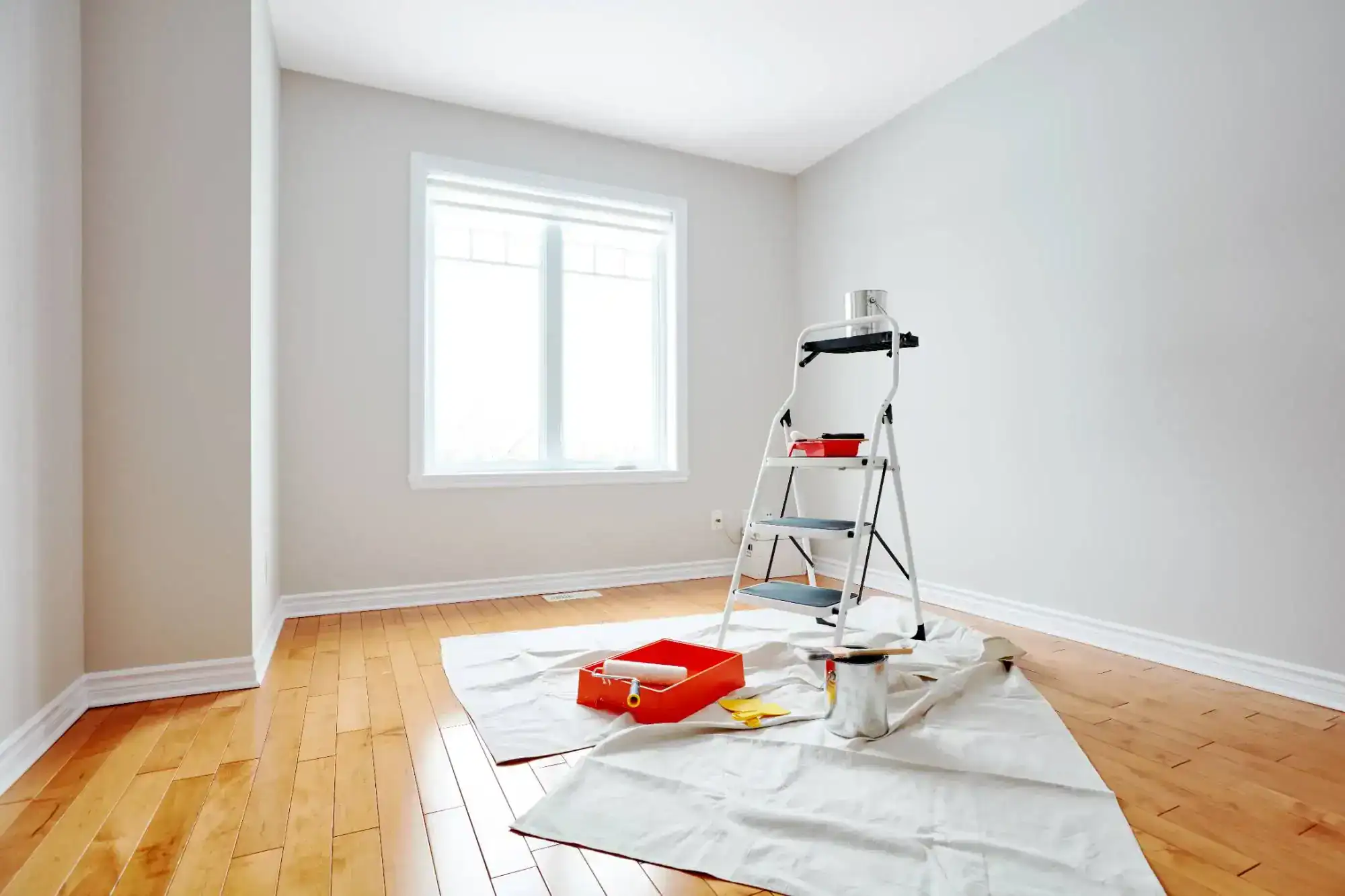
Prep work is where paint jobs succeed or fail. It’s also where contractors cut corners to lower their bids. Surface preparation typically accounts for 40 to 50 percent of total labor time on professional projects. Skip it or rush it, and your paint won’t adhere properly, won’t look smooth, and won’t last.
Proper prep starts with cleaning. Walls need to be free of dust, grease, and residue before paint can bond correctly. Dirty or glossy surfaces cause paint to peel within months. In Michigan, where humidity creates conditions for mold and mildew, cleaning and treating affected areas before painting is essential—not optional.
Sanding comes next. It’s not just a quick pass with a sanding block. Glossy surfaces need thorough scuffing to create tooth for new paint. Damaged areas must be smoothed to avoid visible imperfections under the finish coat. Flaking or peeling old paint has to be completely removed, not painted over, or it’ll fail faster.
Patching and repair work separates adequate prep from quality prep. Nail holes, cracks, and dents need filling with the right compound, proper drying time, and smooth sanding. In Michigan homes, seasonal temperature swings cause hairline cracks and nail pops. Professional painters fix these permanently using mesh tape and three-coat compound applications. Painting over them just makes them show through within months.
Priming is non-negotiable in specific situations, yet it’s often the first thing budget contractors skip. Raw wood, unpainted drywall, stained surfaces, and dramatic color changes all need primer. It improves adhesion, blocks stains and tannins, and ensures even color coverage. Skipping primer on surfaces that need it leads to uneven tones, bleed-through, and premature paint failure.
The cheapest quote usually means minimal prep work. A contractor who quotes significantly lower than others is probably planning to skip steps—cleaning less thoroughly, patching fewer imperfections, applying one coat instead of two, or eliminating primer. You’ll pay less upfront but more later when you’re repainting in two years instead of seven.
Quality prep takes time and adds cost, but it’s the difference between a paint job that lasts and one that disappoints. When you’re comparing estimates, ask specifically what prep work is included. If a contractor can’t detail their prep process or says your walls don’t need much preparation, that’s a warning sign.
The right questions protect you from surprise costs, sloppy work, and contractors who disappear mid-project. These aren’t confrontational—they’re standard for anyone serious about doing quality work.
Start with the basics: Are you licensed and insured? In Michigan, professional painters should carry both general liability and workers’ compensation insurance. Ask to see current certificates. If someone gets hurt on your property or damages your home, insurance protects you from liability. Unlicensed, uninsured contractors might quote lower, but the risk isn’t worth the savings.
What’s included in your estimate? This should cover surface prep, number of coats, type and brand of paint, protection for floors and fixtures, and cleanup. If the estimate is vague or doesn’t break out these details, push for clarification. You need to know what you’re paying for and what might cost extra.
How do you handle unexpected issues? Walls sometimes hide problems that only become visible once work starts—water damage, mold, structural issues. A professional contractor should explain how they’ll communicate these discoveries and get your approval before proceeding with repairs that affect cost.
What’s your timeline and payment schedule? Reputable contractors provide realistic completion dates and stick to them barring weather or unforeseen issues. Payment terms should never require more than 50 percent upfront—many quality contractors require nothing until work is complete. If someone demands full payment before starting, walk away.
Can you provide recent references? Contractors confident in their work gladly share contact information for recent customers. Call those references. Ask about communication, quality, timeliness, and whether the final cost matched the estimate. Past performance predicts future results.
What happens if I’m not satisfied? Quality contractors stand behind their work. Ask about their warranty or guarantee and what recourse you have if paint peels, coverage is uneven, or the finish doesn’t meet expectations. Vague answers or defensiveness to this question tell you everything you need to know.
These questions weed out contractors who cut corners, overpromise, or lack the experience to handle problems professionally. The best painters expect these questions and answer them confidently because they have nothing to hide.
Professional painting services in Macomb County, MI and Oakland County, MI cost what they cost because quality work requires skill, time, proper materials, and thorough preparation. The lowest bid usually means cut corners. The highest doesn’t always mean the best. Smart budgeting means understanding what drives cost and what actually matters for results that last.
Surface prep, paint quality, and experienced application are where your money should go. These are the factors that determine whether you’re repainting in two years or ten. Transparent contractors who itemize their estimates, explain their process, and stand behind their work are worth paying fairly.
When you’re ready for painting services that balance quality workmanship with competitive pricing, we bring over 10 years of painting experience to every residential and commercial project. We focus on doing the job right the first time—thorough prep, quality materials, and attention to detail—so you’ll call us again not because you have to, but because you want to.
Article details:
Continue learning: